SkillVista Piloting in the Netherlands
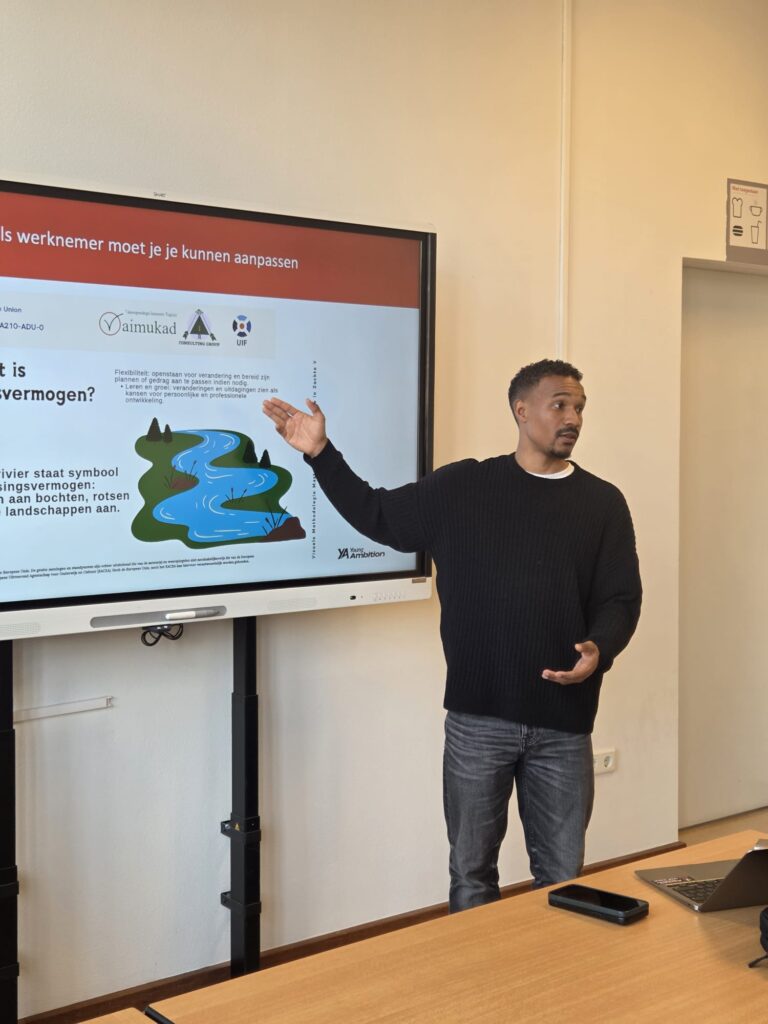

The Dutch piloting phase was implemented in adult education and community learning settings working with vulnerable adult learners, including:
Migrants and newly arrived residents
Adults with low literacy levels
Long-term unemployed individuals
Adults re-entering education
Participants navigating civic integration processes
The groups represented diverse cultural backgrounds, languages, and educational experiences. For many participants, prior schooling had been associated with stress, exclusion, or limited success. This made inclusive, non-text-based learning approaches particularly relevant.
Within the current Dutch social context, adaptability has become a critical transversal skill — essential for employment, integration, and civic participation. For this reason, adaptability was embedded across all sessions rather than addressed as a standalone topic.
Skills Development Focus
The pilot targeted key soft skills:
Communication in multicultural environments
Teamwork and shared responsibility
Problem-solving in real-life civic contexts
Emotional intelligence
Adaptability in changing environments
Special attention was given to intercultural misunderstandings. Through visual mapping, participants explored assumptions, analysed communication breakdowns, and identified alternative responses.
As one learner reflected:
“When we draw it together, it feels easier to understand each other.”
Implementation Approach
Over six weeks, educators implemented the Visual Methodology Mastery Kit (v1) alongside selected modules from the SkillsVista Platform, including:
Scenario-based simulations
Soft skills challenges
Structured visual reflection exercises
Sessions were held bi-weekly and lasted approximately 90 minutes.
Rather than relying on written explanations, educators used visual prompts to initiate dialogue. Learners first mapped situations visually, then discussed them verbally. This reduced pressure, especially for participants with limited Dutch language proficiency.
Visual Tools Applied
The pilot incorporated a range of structured visual instruments:
Communication ecosystem maps
Intercultural misunderstanding diagrams
Emotional reaction wheels
Workplace hierarchy maps
Adaptability ladders
Problem-solving flowcharts
Collaborative drawing played a central role. Instead of completing individual worksheets, participants co-created large visual posters illustrating communication patterns, conflict pathways, and behavioural options. This collective process strengthened engagement and shared ownership of learning.
Educator Development
Prior to the pilot, most educators had theoretical knowledge of visual pedagogy but limited practical experience applying structured visual methodologies.
After six weeks:
Confidence in using visual tools increased significantly
Materials were adapted more effectively to varying literacy levels
Visual thinking evolved from a supplementary aid into a core facilitation method
Group discussions became more balanced and inclusive
Educators noted that visual structures reduced reliance on verbal explanations and created more equal participation across language levels.
Learner Outcomes
Self-assessments indicated consistent improvement across all targeted soft skills.
Participants reported:
Greater clarity in expressing ideas
Increased confidence in collaborative tasks
More structured approaches to problem-solving
Improved emotional awareness
Increased flexibility in unfamiliar situations
One participant shared:
“Pictures helped when I didn’t have the right words.”
Another added:
“I now think about different ways to react instead of only one.”
Educators observed:
High engagement, particularly during collaborative visual tasks
Increased participation from typically quieter learners
Longer sustained attention during scenario discussions
Greater willingness to reflect on behaviour
Initial hesitation about drawing or creativity disappeared after the first sessions. Visual thinking became normalised as part of the learning culture.
Challenges and Insights
Some challenges emerged:
Time constraints
Varied levels of digital literacy
The need for more locally contextualised scenarios
However, these were manageable and provided valuable direction for further refinement.
Inclusion Impact
One of the most significant outcomes of the Dutch pilot was the inclusive nature of visual methodology.
Visual approaches:
✔ Reduced language barriers
✔ Supported learners with low literacy
✔ Encouraged intercultural dialogue
✔ Lowered participation anxiety
✔ Made abstract concepts tangible
Rather than privileging confident speakers or fast processors, visual tasks created space for multiple forms of expression, ensuring more equitable participation across diverse learner groups.
This project has been funded by the Erasmus+ Programme of the European Union.
The European Commission support for the production of this publication does not constitute an endorsement of the contents which reflects the views only of the authors, and the Commission cannot be held responsible for any use which may be made of the information contained therein.
More Posts
Send Us A Message
Primajte novosti i ostanite povezani - Pretplatite se na naš newsletter

SkillVista
Financirano od strane Europske unije. Izneseni stavovi i mišljenja su, međutim, isključivo stavovi autora/autorica i ne odražavaju nužno stavove Europske unije ili Izvršne agencije za obrazovanje i kulturu (EACEA). Ni Europska unija ni EACEA ne mogu se smatrati odgovornima za njih.
- Facebook stranica
- pošta: admin@skillvista.eu