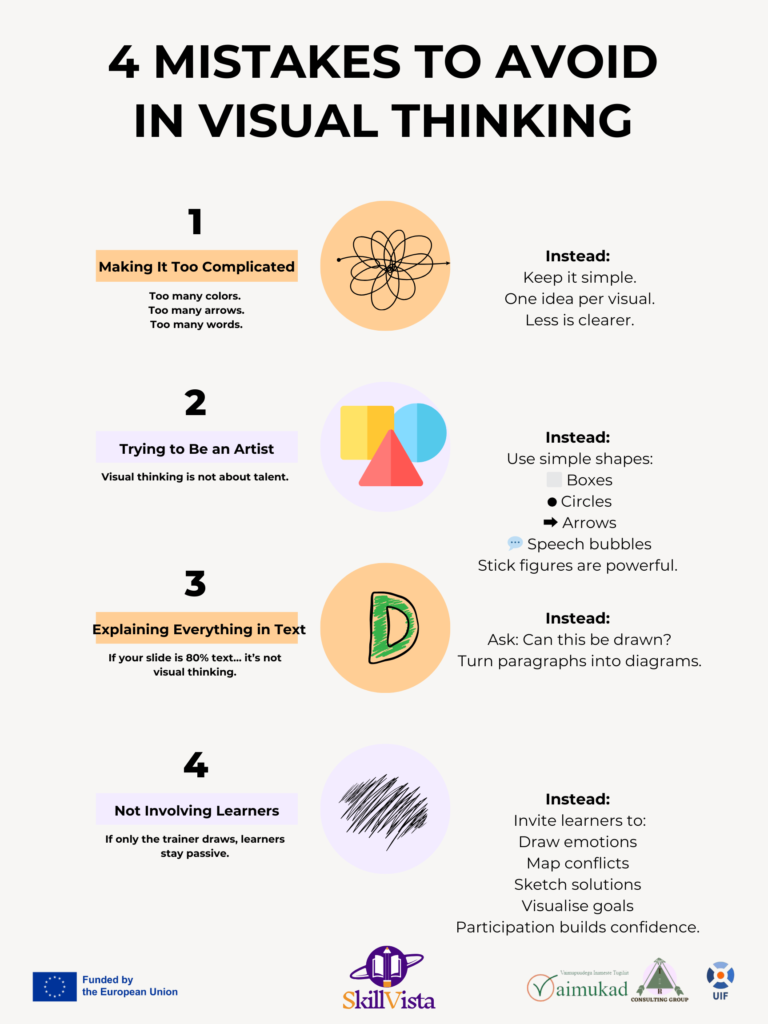
Too many colors.
Too many arrows.
Too many words.
Complex visuals overwhelm instead of clarify.
Instead: Keep it simple.
Use basic shapes:
⬜ Boxes
⬤ Circles
➡ Arrows
💬 Speech bubbles
Stick figures are powerful.
One idea per visual.
Less is clearer.
Visual thinking is not about talent.
It is not about design.
It is not about aesthetics.
It is about structure.
If the drawing helps learners understand a process, reflect on behaviour, or see connections — it works.
Simple beats beautiful.
If your slide is 80% text…
it’s not visual thinking.
Instead ask:
Can this be drawn?
Can I turn this paragraph into a diagram?
Break explanations into flows, maps, or sequences.
Visual structure reduces cognitive overload and supports retention.
If only the trainer draws, learners stay passive.
Visual thinking becomes powerful when learners participate.
Invite them to:
Draw emotions
Map conflicts
Sketch solutions
Visualise goals
Participation builds confidence.
Drawing externalizes thinking.
Co-creating visuals increases ownership.
Ovaj projekt je financiran iz programa Erasmus+ Europske unije.
Podrška Europske komisije za izradu ove publikacije ne predstavlja odobrenje sadržaja, koji odražava isključivo stajališta autora, te Komisija ne može biti odgovorna za bilo kakvu upotrebu informacija koje se u njemu nalaze.
Financirano od strane Europske unije. Izneseni stavovi i mišljenja su, međutim, isključivo stavovi autora/autorica i ne odražavaju nužno stavove Europske unije ili Izvršne agencije za obrazovanje i kulturu (EACEA). Ni Europska unija ni EACEA ne mogu se smatrati odgovornima za njih.