
Käitumise kaardistamise vahend


Käitumise kaardistamise vahend
Make Reactions Visible – Before They Happen
Purpose:
To help learners understand their behaviour patterns, emotional triggers, and alternative responses.
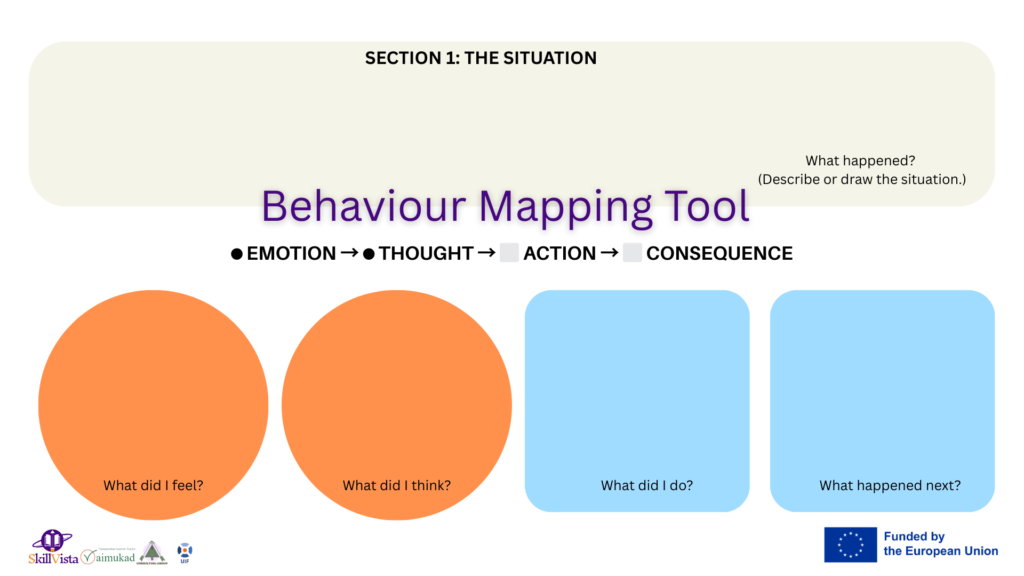
Step 1: The Situation
What happened?
(Describe or draw the situation.)
Example prompts:
- Someone criticises you.
- A colleague ignores you.
- You receive unclear instructions.
Draw it in one simple box.
Step 2: My First Reaction
⬤ What did I feel?
(Emotion – one word or symbol.)
⬤ What did I think?
(First thought.)
⬤ What did I do?
(Action taken.)
Encourage learners to draw arrows between feeling → thought → action.
Step 3: The Consequence
➡ What happened next?
- How did others respond?
- Did the situation improve or escalate?
- What changed?
Draw the outcome in another box.
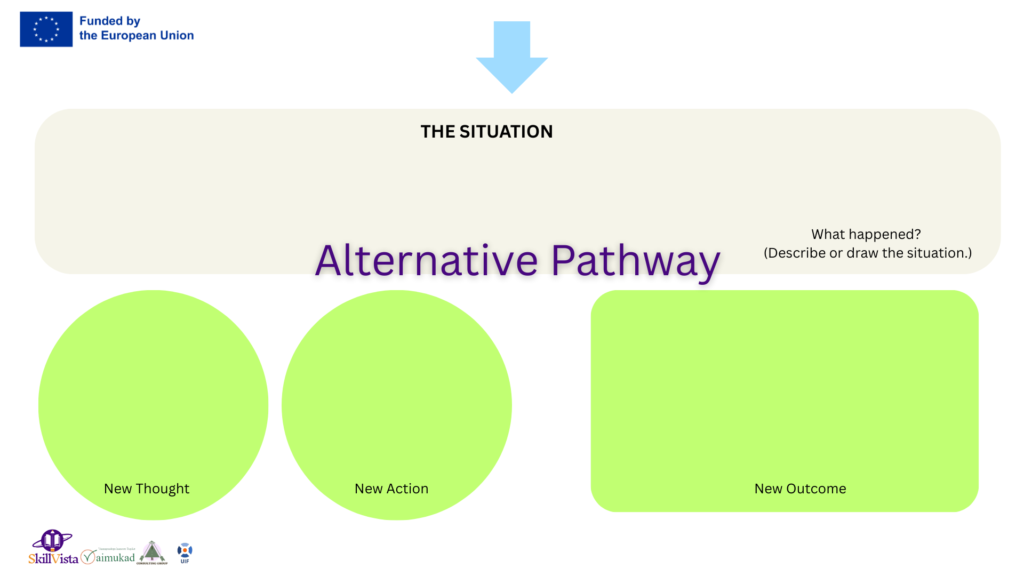
Step 4: Alternative Pathway
🔄 What could I do differently?
Draw a second arrow from the original situation.
- What else could I think?
- What else could I say?
- What else could I do?
Create a “new pathway”.
How to Use in Session
✔ Individual reflection
✔ Pair discussion
✔ Group scenario analysis
✔ Role-play preparation
✔ Conflict resolution workshops
Why It Works
Behaviour mapping:
- Slows down impulsive reactions
- Externalizes thinking
- Reduces defensiveness
- Supports emotional regulation
- Encourages responsibility
- Makes abstract “soft skills” concrete
It transforms “You should behave differently” into
“Let’s see what happened step by step.”
Facilitator Tip
Do not judge the first reaction.
The goal is awareness, not correction.
Once behaviour is visible, change becomes possible.
Seda projekti on rahastatud Euroopa Liidu programmi Erasmus+ raames.
Euroopa Komisjoni toetus käesoleva väljaande koostamisele ei tähenda selle sisu kinnitamist, mis kajastab üksnes autorite seisukohti, ning komisjon ei vastuta selles sisalduva teabe võimaliku kasutamise eest.
Rohkem postitusi
Saada meile sõnum
Saa värskeid uudiseid ja püsi ühenduses – telli meie uudiskiri

SkillVista
Rahastatud Euroopa Liidu poolt. Avaldatud seisukohad ja arvamused on siiski üksnes autori(te) omad ega pruugi kajastada Euroopa Liidu ega Euroopa Hariduse ja Kultuuri Rakendusameti (EACEA) seisukohti. Euroopa Liit ega EACEA ei vastuta nende eest.
- Facebooki leht
- mail: admin@skillvista.eu