Poster

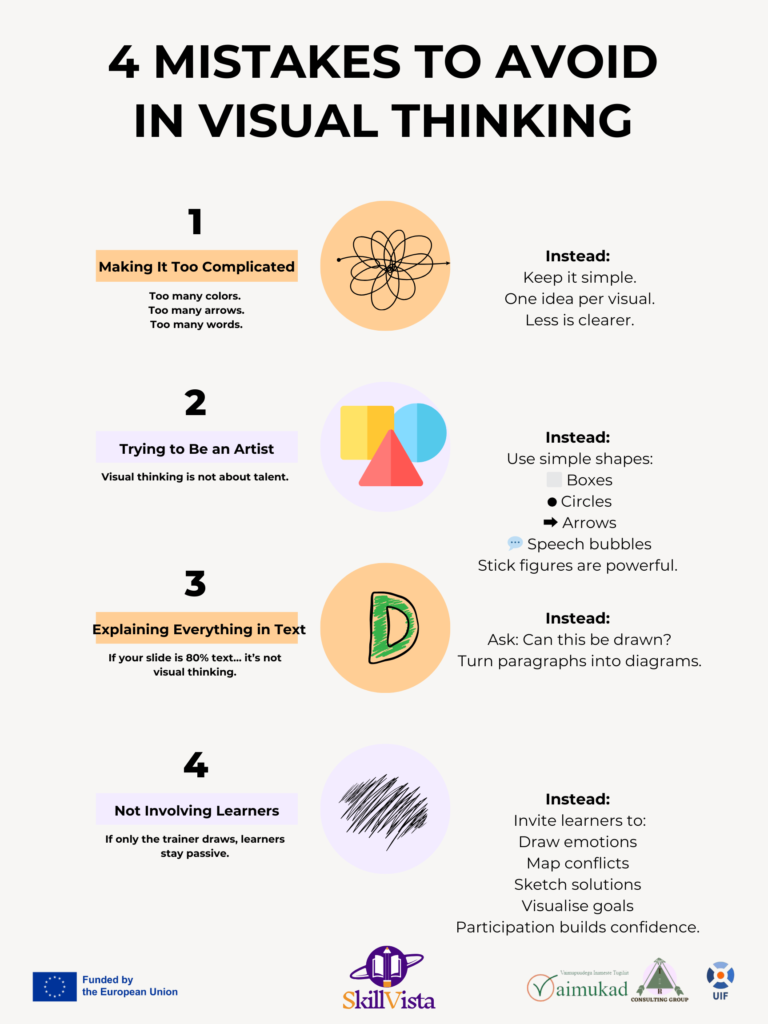
1️⃣ Making It Too Complicated

Too many colors.
Too many arrows.
Too many words.

Complex visuals overwhelm instead of clarify.

Instead: Keep it simple.

Use basic shapes:

⬜ Boxes
⬤ Circles
➡ Arrows
💬 Speech bubbles

Stick figures are powerful.
One idea per visual.
Less is clearer.

2️⃣ Trying to Be an Artist

Visual thinking is not about talent.

It is not about design.
It is not about aesthetics.

It is about structure.

If the drawing helps learners understand a process, reflect on behaviour, or see connections — it works.

Simple beats beautiful.

3️⃣ Explaining Everything in Text

If your slide is 80% text…
it’s not visual thinking.

Instead ask:

  • Can this be drawn?

  • Can I turn this paragraph into a diagram?

Break explanations into flows, maps, or sequences.
Visual structure reduces cognitive overload and supports retention.

4️⃣ Not Involving Learners

If only the trainer draws, learners stay passive.

Visual thinking becomes powerful when learners participate.

Invite them to:

  • Draw emotions

  • Map conflicts

  • Sketch solutions

  • Visualise goals

Participation builds confidence.
Drawing externalizes thinking.
Co-creating visuals increases ownership.

This project has been funded by the Erasmus+ Programme of the European Union. 

The European Commission support for the production of this publication does not constitute an endorsement of the contents which reflects the views only of the authors, and the Commission cannot be held responsible for any use which may be made of the information contained therein.

Get Updates And Stay Connected -Subscribe To Our Newsletter

SkillVista

Funded by the European Union. Views and opinions expressed are however those of the author(s) only and do not necessarily reflect those of the European Union or the European Education and Culture Executive Agency (EACEA). Neither the European Union nor EACEA can be held responsible for them.

Latest Updates