Visual thinking and dual coding in adult softs skills education
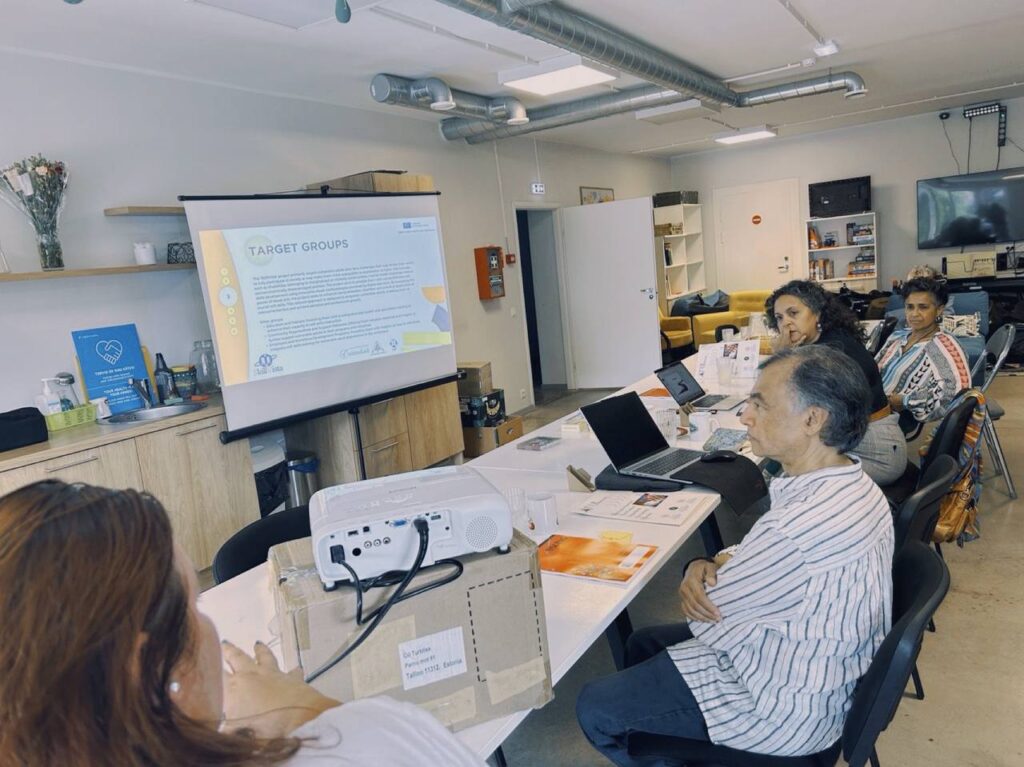

Soft skills are frequently described as essential for employability and social inclusion. Yet across adult education settings, especially those working with vulnerable learners, educators often face a recurring challenge: how to make abstract competencies such as emotional intelligence, communication, or decision-making concrete, understandable, and applicable.
The SkillVista Erasmus+ project approached this challenge through the lens of cognitive science — specifically, Dual Coding Theory and Cognitive Load Theory — to design visual methodologies that enhance comprehension and participation.
Theoretical Foundation: Why Visual + Verbal Works
Allan Paivio’s Dual Coding Theory (1986) proposes that human cognition processes information through two distinct but interconnected systems: a verbal channel and a visual channel. When both channels are activated simultaneously, information is encoded more robustly and becomes easier to retrieve.
In practical terms, this means that when a concept is explained verbally and supported visually, learners build two memory traces instead of one.
In adult soft skills education, this insight is particularly powerful. Many competencies are intangible and relational — for example:
“Active listening”
“Emotional regulation”
“Adaptability”
“Professional boundaries”
These are difficult to grasp through definitions alone. However, when translated into visual maps, structured diagrams, and symbolic representations, they become tangible and navigable.
Reducing Cognitive Load in Vulnerable Adult Education
John Sweller’s Cognitive Load Theory complements this perspective. Working memory is limited. When too much verbal information is delivered at once especially abstract terminology learners may disengage or experience overload.
This is especially relevant for:
- Adults with limited formal education
- Learners with language barriers
- Individuals with learning differences
- Adults experiencing anxiety in structured learning environments
- Visual structuring reduces unnecessary cognitive burden by:
- Organising information spatially
- Highlighting relationships between ideas
- Clarifying sequences in processes
- Making consequences visible
The SkillVista Visual Methodology Mastery Kit intentionally applies this principle by breaking down complex soft skills into structured visual formats.
How SkillVista Applied Dual Coding in Practice
1. Communication as a Visual System
Instead of defining communication theoretically, educators use a visual loop:
Speaker → Message → Listener → Interpretation → Feedback
Learners are invited to map real-life misunderstandings by adding emotional triggers or distortions along the loop. This exercise activates both verbal reflection and visual analysis.
2. Decision-Making Flowcharts
Abstract discussions about “better choices” are replaced with visual decision trees:
Situation → Option A → Consequence A
Situation → Option B → Consequence B
This allows learners to literally see alternative pathways and reflect on cause-and-effect relationships.
3. Emotional Intelligence through Visual Scaling
Emotions are externalised through visual thermometers, symbolic metaphors, or colour-coded intensity scales. Learners identify escalation points and behavioural responses visually before discussing coping strategies.
This externalisation supports metacognitive awareness learners begin to analyse their own thinking and emotional processes.
The European Skills Agenda emphasises upskilling pathways and inclusive lifelong learning. Soft skills are increasingly recognised as critical for sustainable employability and social integration.
This project has been funded by the Erasmus+ Programme of the European Union.
The European Commission support for the production of this publication does not constitute an endorsement of the contents which reflects the views only of the authors, and the Commission cannot be held responsible for any use which may be made of the information contained therein.
More Posts
Send Us A Message
Get Updates And Stay Connected -Subscribe To Our Newsletter

SkillVista
Funded by the European Union. Views and opinions expressed are however those of the author(s) only and do not necessarily reflect those of the European Union or the European Education and Culture Executive Agency (EACEA). Neither the European Union nor EACEA can be held responsible for them.
- Facebook Page
- mail: admin@skillvista.eu