Focus Group report

Focus Group Report
Activity: Development of Visual Methodology Mastery Kit & SkillsVista Platform
Period: August–December 2024
Countries: Estonia, Croatia, Netherlands
. Purpose of the Focus Groups
The focus groups were conducted to:
- Identify priority soft skills for vulnerable adult learners
- Explore learning barriers and engagement challenges
- Assess preferences for visual learning methods
- Gather insights to inform both the Visual Methodology Mastery Kit and the SkillsVista Platform
- Ensure learner-centred and evidence-informed development
The process followed a participatory and inclusive approach aligned with adult learning principles.
2. Methodology
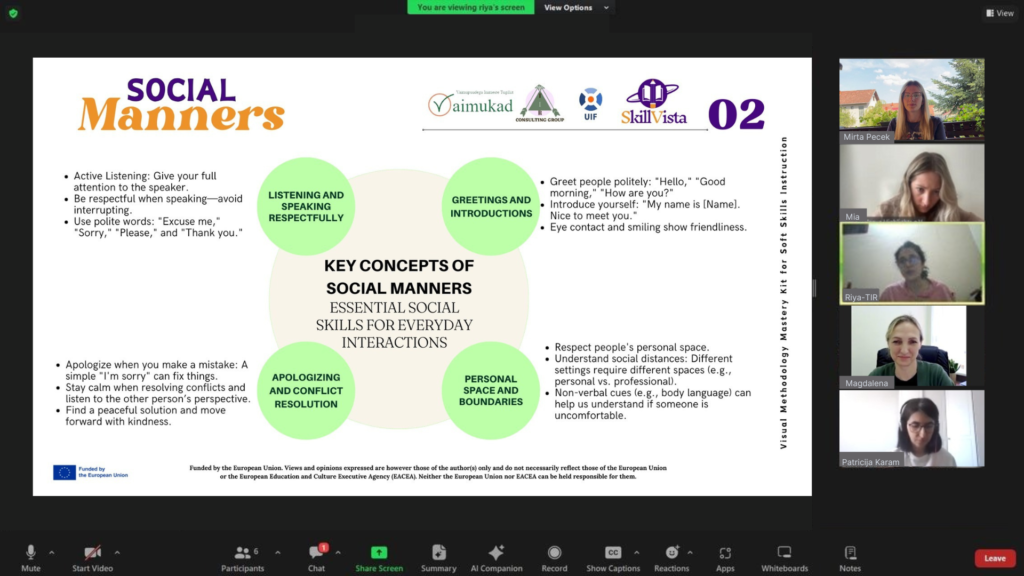
Each partner organisation conducted one national focus group consisting of:
- 5 adult educators/trainers working directly with vulnerable adults
Total participants across 3 countries:
15 educators
Data Collection Methods:
- Semi-structured group discussions
- Guided reflection exercises
- Visual mapping activities
- Short feedback questionnaires
Sessions lasted approximately 2–2.5 hours and were facilitated by trained project staff.
3. Country-Specific Findings
🇪🇪 Estonia
Key Identified Needs:
- Difficulty understanding abstract soft skills terminology
- Need for concrete, step-by-step guidance
- High anxiety in workplace communication
- Challenges with interpreting social norms
Priority Soft Skills Identified:
- Communication
- Social norms & appropriate behaviour
- Time management
- Emotional regulation
Preferred Learning Approaches:
- Clear visual sequences (step-by-step diagrams)
- Emotion scales and pictorial prompts
- Real-life scenario simulations
- Repetition through structured exercises
Outcome for Toolkit:
- Development of simplified visual maps
- Social behaviour flowcharts
- Visual communication models
🇭🇷 Croatia
Key Identified Needs:
- Low self-confidence in professional environments
- Difficulty with decision-making under pressure
- Need for structured problem-solving models
- Workplace adaptability challenges
Priority Soft Skills Identified:
- Decision-making
- Problem-solving
- Adaptability & resilience
- Leadership (basic level)
Preferred Learning Approaches:
- Scenario-based role-play
- Interactive digital challenges
- Gamified elements
- Visual comparison tools
Outcome for Platform:
- Development of interactive quizzes
- Scenario-based digital simulations
🇳🇱 Netherlands
Key Identified Needs:
- Difficulty navigating workplace hierarchy
- Emotional intelligence gaps
- Cultural misunderstandings
- Team collaboration challenges
Priority Soft Skills Identified:
- Emotional intelligence
- Teamwork & collaboration
- Social manners
- Leadership in group contexts
Preferred Learning Approaches:
- Visual metaphors
- Group-based reflection exercises
- Dialogue simulations
- Peer learning discussions
Outcome for Toolkit & Platform:
- Emotion mapping visuals
- Teamwork diagrams
- Public vs. private behaviour scenarios
4. Cross-Country Comparative Analysis
Across all three countries, several consistent themes emerged:
Abstract Concepts Are Difficult
Participants across countries struggled with purely theoretical explanations of soft skills.
Visual Structure Enhances Confidence
Learners expressed feeling “less afraid” when concepts were visually broken down.
Scenario-Based Learning Is Highly Effective
Both educators and learners preferred realistic, contextual situations rather than lecture-style teaching.
Emotional Intelligence Requires Structured Guidance
Emotion identification and regulation were common challenges across all countries.
5. Key Decisions Derived from Focus Groups
Based on findings, the partnership agreed to structure the Toolkit into 10 modules:
- Communication
- Social Manners
- Social Norms & Inappropriate Behaviour
- Teamwork & Collaboration
- Decision-Making
- Problem-Solving
- Adaptability & Resilience
- Time Management
- Leadership
- Emotional Intelligence
Additionally:
- Visual explanations would be prioritised over text-heavy descriptions
- Activity suggestions would accompany each module
- The digital platform would complement the toolkit through scenario-based simulations
- Content would be translated into national languages to ensure accessibility
This project has been funded by the Erasmus+ Programme of the European Union.
The European Commission support for the production of this publication does not constitute an endorsement of the contents which reflects the views only of the authors, and the Commission cannot be held responsible for any use which may be made of the information contained therein.
More Posts
Send Us A Message
Get Updates And Stay Connected -Subscribe To Our Newsletter

SkillVista
Funded by the European Union. Views and opinions expressed are however those of the author(s) only and do not necessarily reflect those of the European Union or the European Education and Culture Executive Agency (EACEA). Neither the European Union nor EACEA can be held responsible for them.
- Facebook Page
- mail: admin@skillvista.eu